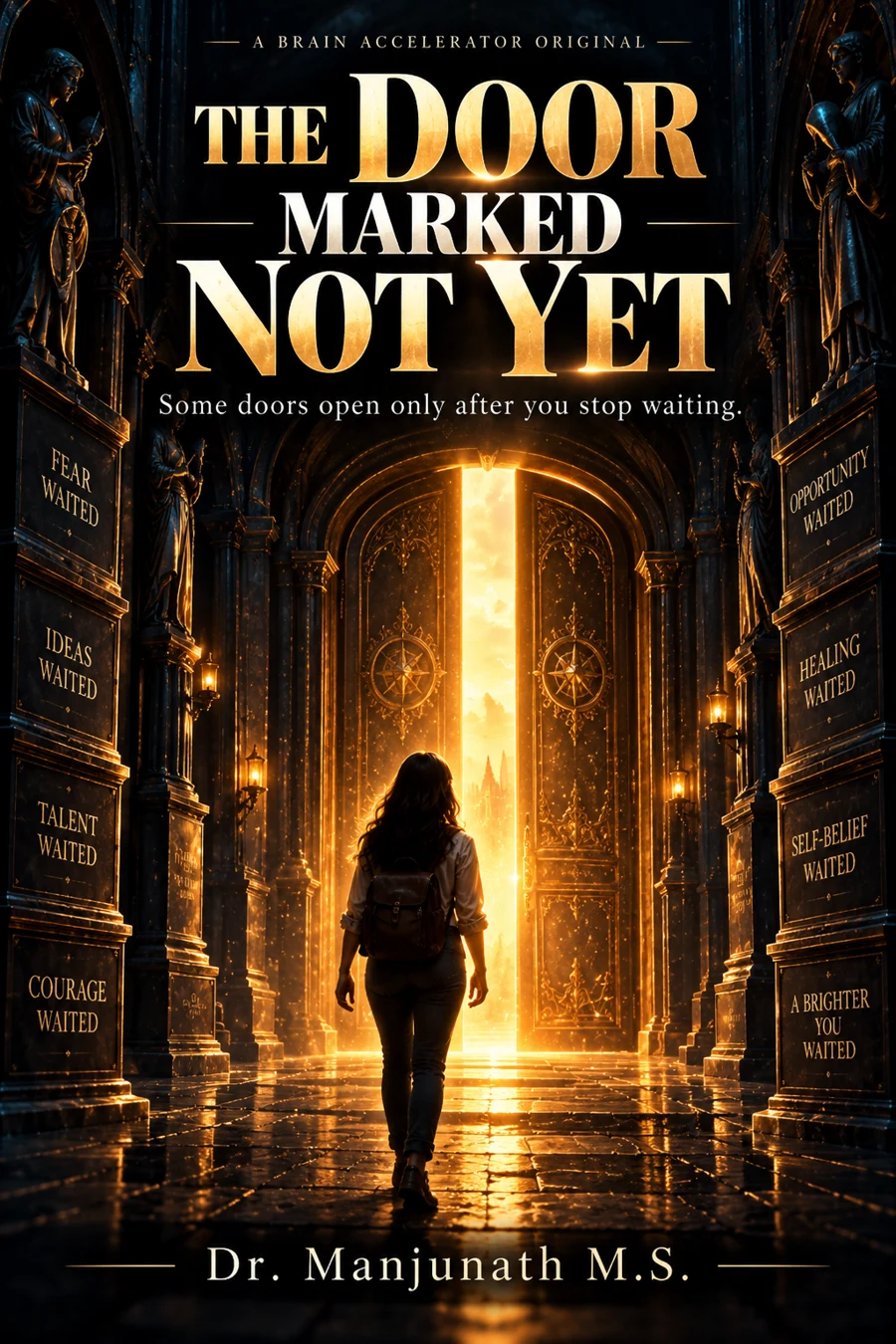
The Door That Wasn't There Yesterday
11:47 PM.
The last train had already departed.
Leena stood alone on Platform Seven, holding a brown envelope against her chest.
Rainwater dripped from the station roof.
Somewhere in the distance, a clock struck midnight.
She looked at the departure board.
NO MORE TRAINS TONIGHT.
"Perfect," she whispered.
Another thing she had missed.
She turned toward the exit.
That's when she noticed the door.
It stood at the end of a narrow corridor beside the staircase.
Tall.
Black.
With a golden handle.
Above it, someone had painted two words.
NOT YET.
Leena stopped.
She had used this railway station for eleven years.
That door had never been there.
She stepped closer.
A faint golden light escaped through the gap beneath it.
Then she heard a voice.
"You can come in, you know."
Leena froze.
"Who's there?"
"Someone who's been waiting for you."
She looked behind her.
The platform was empty.
"Waiting for me?"
"For quite some time."
She reached for the handle.
But before touching it, she noticed something scratched into the wood.
When you're ready.
Leena withdrew her hand.
"I'm not ready," she whispered.
The voice replied.
"I know."
The Woman Who Almost Began
Leena was thirty-six.
She was a talented architect.
At least, that's what people told her.
She designed beautiful buildings for other people.
Office towers.
Luxury apartments.
Expensive homes with enormous windows and perfectly arranged gardens.
But there was one project she had never completed.
Her own.
For seven years, she had carried a dream of designing affordable, beautiful community spaces for children.
Small libraries.
Safe playgrounds.
Places where children from crowded neighborhoods could learn, imagine and discover possibilities.
She had studied everything.
Sustainable architecture.
Urban planning.
Community design.
Funding models.
She had attended workshops, collected research papers and filled several notebooks.
Her laptop contained a folder titled:
MY FUTURE PROJECT.
Inside were forty-three versions of the same proposal.
Version 1.
Version 2.
Version 17.
Version 28 FINAL.
Version 28 FINAL REVISED.
Version 43 FINAL FINAL.
Yet she had never submitted it.
There was always something missing.
More research.
A better presentation.
A stronger financial model.
The right partner.
The perfect opportunity.
That evening, she had missed the deadline for a city innovation fellowship.
Again.
The brown envelope she held contained the printed application.
She had carried it around all day.
Never once entering the office where it needed to be submitted.
Now, standing in front of a mysterious door, she felt an uncomfortable familiarity.
NOT YET.
Those two words had followed her for years.
The Room of Unfinished Things
Leena pushed the door.
It opened without resistance.
Inside was a vast room illuminated by hundreds of suspended golden lamps.
The walls disappeared into darkness.
In the center stood a long wooden table.
On it were objects.
A guitar with three strings.
A half-finished painting.
An unopened letter.
A pair of running shoes.
A small wooden airplane without wings.
And at the far end, an architectural model.
Leena walked toward it.
Her breath caught.
It was her community learning center.
Exactly as she had imagined it.
The curved entrance.
The open courtyard.
The reading room with enormous windows.
Even the yellow tree she wanted to plant in the center.
But half the building was missing.
Its walls ended abruptly.
The roof was unfinished.
Tiny chairs stood beneath an open sky.
"Beautiful, isn't it?"
Leena turned.
A young man stood beside the table.
He looked about twenty-five.
His sleeves were rolled up, and his hands were covered in paint.
"Who are you?" she asked.
"My name is Dev."
"What is this place?"
"A workshop."
"For what?"
"Things people haven't finished."
Leena looked around.
"Who owns all this?"
Dev smiled.
"Different people."
"And my design?"
"Yours, apparently."
She stepped toward the model.
"How did you get this?"
"That's not the interesting question."
"Then what is?"
Dev pulled out a chair.
"Why is it still unfinished?"
Leena hesitated.
"Because I haven't found the right funding."
"I see."
"And the location is uncertain."
"Of course."
"And there are permissions, regulations, suppliers—"
"Yes."
"It's complicated."
Dev nodded.
"Very complicated."
She folded her arms.
"You're making fun of me."
"Not at all."
He picked up the little wooden airplane.
Its wings were missing.
"Do you know who made this?"
"No."
"A twelve-year-old boy. He wanted to build a model airplane with his father."
"What happened?"
"He started. Then he made a mistake."
Dev turned the airplane over.
One side had been glued incorrectly.
"He thought he'd ruined it, so he put it away."
"That's sad."
"Perhaps."
Dev placed it back.
"His father never knew the boy wanted help."
Leena stared at the small airplane.
"Why didn't he ask?"
Dev looked at her.
"That's an interesting question."
The Bridge Without a Beginning
Dev led her toward another part of the room.
There, suspended above a dark pool of water, stood an unfinished wooden bridge.
It connected two stone platforms.
Or rather, it almost connected them.
Only the first few sections had been built.
Beyond them was an empty gap.
On the opposite platform stood a single golden lamp.
"What's that?" Leena asked.
"A bridge."
"Obviously. Why isn't it finished?"
"Nobody has built the next section."
"Why?"
"They keep waiting until they know exactly how the whole bridge will turn out."
Leena examined the structure.
"That sounds sensible. Bridges need engineering."
Dev smiled.
"Then perhaps you can help."
He handed her a drawing.
It showed the platform dimensions, timber strength and load requirements.
Leena studied it.
"This is incomplete."
"Yes."
"We need measurements."
Dev pointed toward a workbench.
There were measuring tapes, clamps, timber samples and weights for testing.
Leena looked surprised.
"You have the tools."
"Some of them."
"And materials?"
"Enough for a trial section."
"Then why hasn't anyone tested it?"
Dev looked toward the unfinished bridge.
"Because a test might fail."
Leena almost laughed.
"Of course it might fail. That's why you test."
Dev said nothing.
The room became quiet.
Leena looked down at the engineering drawing.
Then at the half-finished bridge.
She understood what he was waiting for her to notice.
"I see what you're doing," she said.
"What am I doing?"
"Trying to make some point about my project."
"Am I?"
"You think I should just begin, even if I don't know what I'm doing."
Dev shook his head.
"No."
Leena frowned.
"Then what?"
"I think you know quite a lot about what you're doing."
He picked up a measuring tape.
"And you've forgotten what it's like to discover the things you don't know."
Leena looked at the bridge again.
"So you want me to build it?"
"Only if you want to."
She examined the first section carefully.
The supports were secure.
The available timber could be tested.
The next step was small enough to attempt safely.
"All right," she said.
"Let's test one section."
Twenty minutes later, their first timber sample cracked under the test weight.
Leena stepped back.
"There. It failed."
Dev nodded.
"What did you learn?"
She examined the break.
"Wrong thickness. And this joint needs reinforcing."
"Can you improve it?"
"Of course."
She stopped.
The words surprised her.
She had spent years imagining failure as a verdict.
But standing beside a broken piece of wood, she felt something entirely different.
Curiosity.
She picked up a pencil.
"Give me another sheet."
The Question Behind the Door
When Leena returned to the long wooden table, the architectural model had changed.
One section of the community center now had a finished roof.
She stared at it.
"Did you change this?"
Dev shook his head.
"I haven't touched it."
"Then how—"
"Does it matter?"
"Yes!"
He smiled.
"Then perhaps this isn't the room for answers."
He walked toward the door.
"It's getting late."
Leena followed him.
Before leaving, she turned toward her unfinished model.
"What happens to all these things?"
"Some are completed."
"And the others?"
"They stay here."
"Forever?"
Dev looked thoughtful.
"Until someone decides what to do with them."
Leena looked at the half-built airplane.
The painting.
The guitar.
The unopened letter.
"Do people ever come back?"
"Sometimes."
"And what if they don't?"
Dev was quiet for a moment.
"Then the world never discovers what those things might have become."
Leena felt a strange heaviness.
She thought of her forty-three proposals.
The sketches.
The late nights.
The excitement she used to feel when she imagined children discovering a beautiful place to learn.
She had called it preparation.
But somewhere along the way, preparation had become a comfortable place to hide.
"Can I ask you something?" she said.
"Of course."
"What if I begin and discover that I'm not capable?"
Dev leaned against the doorway.
"Then you'll know something you don't know today."
"What?"
"Where you need help."
Leena looked down.
"And what if people reject my proposal?"
"Some might."
"And what if I fail?"
Dev considered her question.
"Would you rather learn that one proposal didn't work, or spend another seven years wondering whether it could have?"
She didn't answer.
Then Dev opened the door.
Beyond it was the empty railway platform.
The rain had stopped.
The departure board was dark.
Leena stepped outside.
"Wait," she said.
Dev was already closing the door.
"How do I come back?"
He paused.
"Why would you need to?"
"What if I'm not ready?"
Dev looked at her.
"Leena, you don't have to be ready for everything."
He glanced at the brown envelope in her hands.
"Only for the next step."
The door closed.
The First Knock
8:32 AM.
Leena sat at her kitchen table.
Her brown envelope lay beside a cup of coffee.
The fellowship deadline had passed.
There was nothing she could do about it.
For a while, she stared at the envelope.
Then she opened her laptop.
She found the name of a community organization that worked with children in underserved neighborhoods.
She had saved their contact details fourteen months earlier.
She had even drafted an email.
The message was still in her drafts folder.
Subject: Proposal for a Community Learning Space
She opened it.
Nine paragraphs.
Architectural concepts.
Sustainability features.
Long-term development plans.
She read it carefully.
Then deleted most of it.
She wrote:
Hello,
I'm Leena, an architect interested in designing small community learning spaces.
I've been developing an idea and would love to understand whether something like this could be useful to your organization.
Could we schedule a short conversation?
I can share a simple concept sketch beforehand.
She read the email again.
It wasn't impressive.
It didn't contain her entire vision.
It didn't prove that she was capable of building anything.
It simply asked for a conversation.
Her finger hovered over Send.
Then the familiar thoughts returned.
What if they ignore me?
What if they ask something I can't answer?
What if they think the idea is foolish?
She leaned back.
The room was quiet.
She remembered the unfinished bridge.
The broken timber.
The pencil Dev had handed her.
She took one slow breath.
And clicked.
MESSAGE SENT.
Nothing extraordinary happened.
No applause.
No golden light.
No sudden certainty.
Her coffee was getting cold.
The kitchen needed cleaning.
Her office meeting was scheduled for ten.
Everything looked exactly as it had before.
Except one thing.
The email was no longer in Drafts.
The Door Opens
Three weeks later, Leena stood inside a small community center.
Its paint was fading.
Its chairs were mismatched.
One window wouldn't close properly.
A woman named Fatima was showing her around.
"We don't have much funding," Fatima explained.
"And I can't promise anything. But we'd love a reading corner for the children."
Leena nodded.
"Could I measure this room?"
"Certainly."
She opened her bag.
Inside were a notebook, measuring tape and pencil.
No elaborate presentation.
No forty-fourth proposal.
Just the tools she needed for the next step.
That afternoon, Leena drew a simple layout.
A small bookshelf.
A reading bench.
Two tables.
Better lighting.
A quiet corner.
Nothing grand.
Nothing extraordinary.
But something real.
She showed the sketch to Fatima.
"We could start with this section," Leena said. "If funding allows, we can expand later."
Fatima examined the drawing.
"I think the children would love it."
Leena smiled.
For the first time in years, her dream was no longer entirely inside her imagination.
It had entered a conversation.
A room.
A possibility shared with another person.
That evening, on her way home, she passed the railway station.
She walked down the familiar corridor.
The door was gone.
There was only an ordinary white wall.
Leena touched it.
Nothing happened.
She almost laughed.
Perhaps she'd imagined the whole thing.
Perhaps she'd fallen asleep waiting for the train.
Perhaps she'd been more exhausted than she realized.
She turned to leave.
Then noticed a tiny piece of paper lying near the wall.
She picked it up.
It was a folded engineering sketch.
A bridge.
Only the first section had been completed.
At the bottom, in familiar handwriting, were four words.
WHAT WILL YOU BUILD NEXT?
Leena smiled.
She folded the paper and slipped it into her bag.
Outside, morning sunlight was beginning to fill the streets.
She had no idea whether the community center would ever be built.
No guarantee that the organization would find funding.
No certainty that her design would succeed.
But tomorrow she had another meeting.
And this time, she intended to arrive.
What was the door really waiting for?
Theme: Procrastination, uncertainty, courage and focused execution.
Three key takeaways
- Readiness is not always a prerequisite for action. Sometimes, we develop readiness by taking small, thoughtful steps.
- Failure can provide useful information. A carefully designed experiment helps us discover what needs improvement.
- Big goals become achievable through smaller actions. Progress begins when an idea moves from imagination into the real world.
Reflection question
What meaningful goal have you repeatedly postponed because you're waiting to feel completely ready?
Your 24-hour challenge
Identify one important goal you've been postponing. Choose a small, low-risk action you can complete within the next 24 hours—a conversation, an email, a first draft or a simple experiment.
You don't need to see the entire staircase to take the next safe step.