10:17 P.M.
The piano had been silent for twenty years.
At least, that was what everyone in the neighborhood believed.
But on a rainy Thursday night, Kavya heard it playing.
Three notes.
A pause.
Three notes again.
She stopped beneath a flickering streetlight.
Across the road stood the old Vardhan Concert Hall. Its iron gates were rusted, its windows covered with dust.
A faded board hung above the entrance.
CLOSED UNTIL FURTHER NOTICE.
Kavya checked her watch.
10:17 PM.
She had an unfinished project, seventeen unread messages and a client expecting a response before midnight.
She should have kept walking.
But the music returned.
Three notes.
A pause.
Something about that pause troubled her.
It felt as though the piano was waiting for an answer.
She crossed the road.
The Empty Concert Hall
The wooden door opened with a long, reluctant creak.
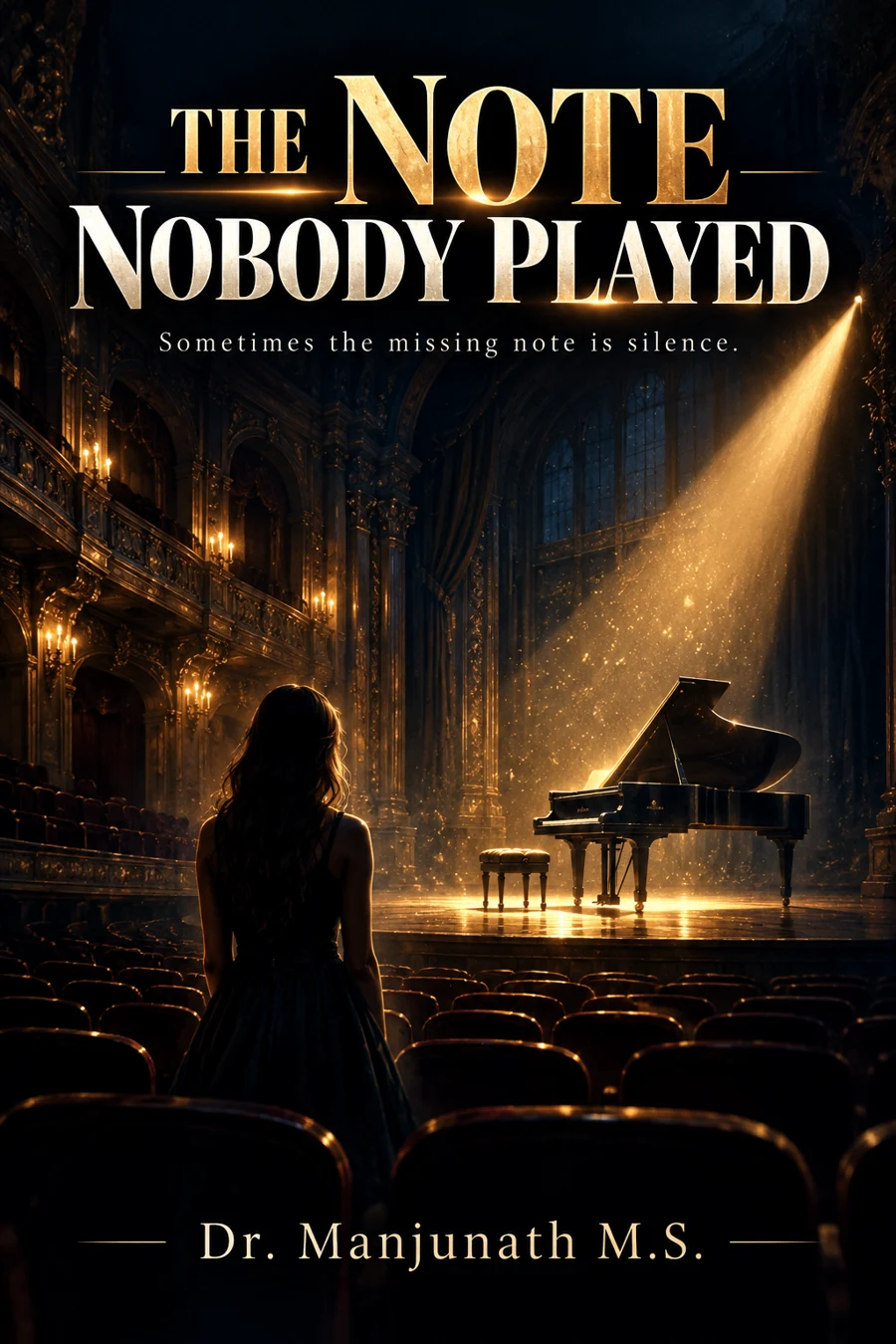
Inside, hundreds of empty red seats faced a small stage.
Dust floated through a narrow beam of golden light.
In the center stood a grand piano.
Its keys were moving.
Nobody was sitting in front of it.
Kavya froze.
"Hello?"
No answer.
The piano played again.
Three notes.
A pause.
"Who's there?"
"You're standing in the wrong place."
Kavya spun around.
An elderly man stood near the entrance, holding a broom.
He was dressed in a faded grey shirt and slippers.
"You frightened me!" she said.
"And you interrupted the performance."
She looked toward the empty stage.
"What performance? There's nobody playing."
"Exactly."
The old man resumed sweeping.
Kavya walked closer.
"How is the piano playing by itself?"
"An old mechanical system. I repaired it last week."
"Why?"
"Because someone was going to throw it away."
Kavya looked around.
"Is this place reopening?"
"No. They're clearing the building next month."
"Then why repair a piano?"
The old man stopped sweeping.
"Because something doesn't become meaningless simply because nobody is paying attention to it."
Kavya gave him a puzzled look.
Her phone vibrated.
She glanced at it.
Three new messages.
The old man noticed.
"Important?"
"Probably."
"Then you should answer."
Kavya unlocked the screen.
One message was a promotional offer. Another was from a colleague about tomorrow's meeting.
The third was from her daughter, Anya.
Mumma, did you listen to what I sent you?
Kavya typed:
Tomorrow, sweetheart. Busy right now.
She put the phone away.
"So," she said, "what's special about this piano?"
The old man smiled.
"Perhaps you should listen."
The Missing Note
Kavya sat in the front row.
The piano began again.
Three notes.
A pause.
Three notes.
Another pause.
After the fourth repetition, she became irritated.
"Why doesn't it finish?"
The old man leaned against the wall.
"What makes you think it hasn't finished?"
"Because the melody is incomplete."
"How do you know?"
"I'm a sound editor. I work with music and recordings every day."
"Ah. Then perhaps you can tell me what's wrong."
Kavya listened again.
The first note rose gently.
The second was lower.
The third lingered.
And then came the silence.
"It needs one more note," she said.
"Which one?"
"I don't know. Something that resolves the melody."
The old man walked toward the piano.
He opened a wooden box and removed a yellowed sheet of music.
"Look."
Kavya examined it.
Three notes.
Then a musical rest.
No fourth note.
"Someone forgot to complete the composition," she said.
"Or perhaps you are adding something the composer never intended."
"Why would anyone deliberately leave a melody unfinished?"
"Have you ever listened to someone who was struggling to find the right words?"
Kavya frowned.
"Of course."
"What do you do while they're thinking?"
"I wait."
"Do you?"
The question irritated her.
"What are you trying to say?"
"Nothing."
He returned the sheet to its box.
"I'm asking you to listen."
Kavya folded her arms.
The music began again.
This time, she focused on the silence.
She heard rain against the roof.
A faint hum from the old electrical wiring.
The movement of the man's broom.
Somewhere outside, a motorcycle passed.
The piano played its final note.
And the sound slowly dissolved into the hall.
For the first time, Kavya noticed that the music had not actually stopped when the key stopped moving.
Its echo continued.
Gently.
Almost invisibly.
The old man spoke.
"You were so busy waiting for the next note that you missed what the previous one was doing."
Kavya said nothing.
The Woman Who Removed Silence
"What do you edit?" the old man asked.
"Interviews. Podcasts. Presentations. Sometimes documentaries."
"And what does a sound editor remove?"
"Unnecessary noise. Mistakes. Long pauses."
"Long pauses?"
"People don't like waiting. If someone takes five seconds to answer a question, I shorten it. Makes everything flow better."
The old man nodded thoughtfully.
"Interesting."
"What's interesting?"
"You spend your days removing the moments when people are thinking."
Kavya laughed.
"That's not fair."
"Perhaps not."
He pulled a chair beside her.
"May I show you something?"
He took out an old recording device and pressed Play.
A woman's voice filled the hall.
"I don't know how to say this."
Silence.
The woman breathed.
"I've wanted to tell you for a very long time that…"
Another pause.
Her voice trembled.
"I'm proud of you."
The recording ended.
Kavya waited.
The old man pressed another button.
The same voice returned.
"I don't know how to say this. I've wanted to tell you for a very long time that I'm proud of you."
It sounded polished.
Clear.
Professional.
But something had changed.
"Which version would you keep?" he asked.
Kavya thought for a moment.
"The first."
"Why?"
"Because…"
She stopped.
In the first recording, she had heard something that no sentence could communicate.
Hesitation.
Vulnerability.
The courage it took to finally say the words.
In the second, she had heard only information.
"Whose voice is that?" she asked.
The man looked toward the stage.
"My wife. She used to teach music here."
"Where is she now?"
He was quiet for a few seconds.
"She died eight years ago."
Kavya lowered her eyes.
"I'm sorry."
He smiled faintly.
"Don't be. We had forty-three good years."
He placed the recorder back into its case.
"She always said the notes tell you what the musician is playing. The spaces sometimes tell you what the musician is feeling."
They sat without speaking.
This time, Kavya didn't rush to fill the silence.
The Message
It was almost eleven when Kavya finally stood up.
"I should go."
The old man walked her toward the entrance.
"Will you come back?"
She glanced at the empty seats.
"Maybe."
"That's what everyone says."
They both laughed.
Outside, the rain had stopped.
Kavya took out her phone.
Twelve new notifications.
She was about to open her email when she noticed Anya's earlier message.
Mumma, did you listen to what I sent you?
Beneath it was an audio recording.
Two minutes and fourteen seconds.
Kavya pressed Play.
"Hi, Mumma."
It was her daughter's voice.
"Our teacher asked us to record something we want to tell our parents."
A pause.
"I didn't really know what to say."
Another pause.
Kavya could hear a ceiling fan turning in the background.
"Everyone talks about how busy their parents are."
The girl laughed softly.
"I know you're busy too."
Silence.
Kavya almost checked the screen to see whether the recording had stopped.
But then Anya spoke again.
"Sometimes, when I tell you about my day, you already know what I should do before I finish telling you."
Kavya stopped walking.
"I know you're trying to help me."
Another pause.
"But sometimes I don't want advice."
The girl's voice became quieter.
"Sometimes I just want to tell you everything."
The recording continued.
Anya began describing a disagreement she'd had with a friend.
She talked about feeling embarrassed.
About wanting to apologize.
About being afraid her friend wouldn't forgive her.
For once, Kavya didn't interrupt.
Didn't suggest a solution.
Didn't mentally prepare a response.
She listened.
All the way to the end.
The final words were almost a whisper.
"Okay. That's all. Love you, Mumma."
Kavya stood beneath the streetlight for a long time.
She had listened to thousands of recordings in her career.
She knew how to remove noise, sharpen voices and make every second count.
But she couldn't remember the last time she'd allowed someone she loved to speak without silently editing their words.
The Fourth Note
Anya was awake when Kavya reached home.
She was sitting on her bed, reading.
"Mumma?"
"Hmm?"
"You're late."
"I know."
Kavya sat beside her.
"I listened to your recording."
Anya closed her book.
"Oh."
"All of it."
"Okay."
Kavya almost said, You know, when your friends upset you, the best thing is to…
The advice was ready.
Familiar.
Automatic.
Instead, she asked, "Would you like to tell me more about what happened?"
Anya looked surprised.
"Now?"
"Now."
"But aren't you tired?"
"A little."
"Don't you have work?"
"It can wait."
Anya studied her face.
Then began speaking.
At first, slowly.
Then faster.
She told her mother about the argument.
About something she had said.
About something she wished she hadn't said.
Halfway through, she stopped.
Kavya waited.
Ten seconds passed.
Anya looked at her.
"Aren't you going to say anything?"
"I'm listening."
Anya smiled.
Then something unexpected happened.
She found her own answer.
"I think I should just call her tomorrow and apologize."
Kavya smiled back.
"That sounds like a good idea."
Anya moved closer and rested her head against her mother's shoulder.
They stayed that way for a while.
No advice.
No notifications.
No urgency.
Just two people sharing a quiet moment.
And Kavya understood something the old man had never actually explained.
Sometimes, the space you leave is what allows another person to find their voice.
The Concert That Never Ended
Three weeks later, the Vardhan Concert Hall was demolished.
Kavya went there one final time.
The piano was gone.
The red seats had been removed.
Only the empty stage remained.
The elderly man was standing near the entrance.
"Did you find the missing note?" he asked.
Kavya smiled.
"I think so."
"What was it?"
She looked toward the empty stage.
For a moment, she could almost hear the melody.
Three notes.
A pause.
But this time, she wasn't waiting for a fourth.
She was listening to everything the silence allowed her to hear.
"There wasn't a missing note," she said.
The old man nodded.
"Then perhaps you heard the whole song."
Kavya walked away.
Her phone vibrated in her pocket.
She noticed it.
Then continued walking beneath the morning sky.
There would be time to answer.
For now, she wanted to hear the birds.
What was the real missing note?
Theme: Attention, presence, emotional awareness and mindful communication.
Three key takeaways
- Attention is more than concentration. It is also the ability to notice what is happening without constantly preparing your next response.
- Not every pause needs to be filled. Silence can give us space to reflect, understand and connect.
- Listening is an active skill. Sometimes, the greatest support we can offer is allowing another person to finish expressing their thoughts.
Reflection question
When someone speaks to you, are you truly listening—or are you already preparing what you're going to say?
Your 24-hour challenge
During one important conversation today, allow the other person to finish speaking. Don't interrupt, offer advice immediately or look at your phone. Notice what changes.