The Book That Knew Her Name
9:43 PM.
The bookshop had no name.
No signboard.
No advertisements.
Just a narrow wooden door between a closed pharmacy and an abandoned cinema.
Meera would have walked past it, as she had walked past hundreds of places without really seeing them.
But something caught her attention.
A book stood alone in the window.
Its cover was dark blue.
Its title was written in faded gold.
THE LIFE YOU ALMOST LIVED.
Beneath the title, someone had written a name.
Meera.
She stopped.
That was her name.
She stepped closer.
Through the dusty glass, she could see another line.
For the woman who kept preparing to begin.
Meera felt a strange chill.
She looked at her reflection in the glass.
"That's not funny," she whispered.
Somewhere inside the shop, a bell rang.
The door opened.
A Woman Who Had Read Everything
Meera was thirty-eight.
She worked in a technology company, managed a team of twelve people and had a personal library of 317 books.
She loved books.
Books about productivity.
Books about creativity.
Books about confidence, habits, leadership, psychology and personal transformation.
Her apartment had three large bookshelves.
She had highlighted thousands of sentences.
Filled dozens of notebooks.
Completed several reading challenges.
Yet every December, when she opened her journal to review the year, the same sentence appeared.
Next year, I'll finally begin.
Begin what?
She could never give a satisfactory answer.
There had once been many things.
Learning to paint.
Writing children's stories.
Traveling alone.
Starting a community learning space.
Somewhere along the way, those dreams had slowly become reading material.
A book about painting felt almost like painting.
A book about writing felt almost like writing.
Reading about courage made her feel brave for an evening.
And buying another book gave her the quiet satisfaction of having made progress.
That evening, she had purchased three more books.
They were still inside her handbag.
She stepped into the mysterious shop.
"Hello?"
The room smelled of old paper, polished wood and something warm she couldn't identify.
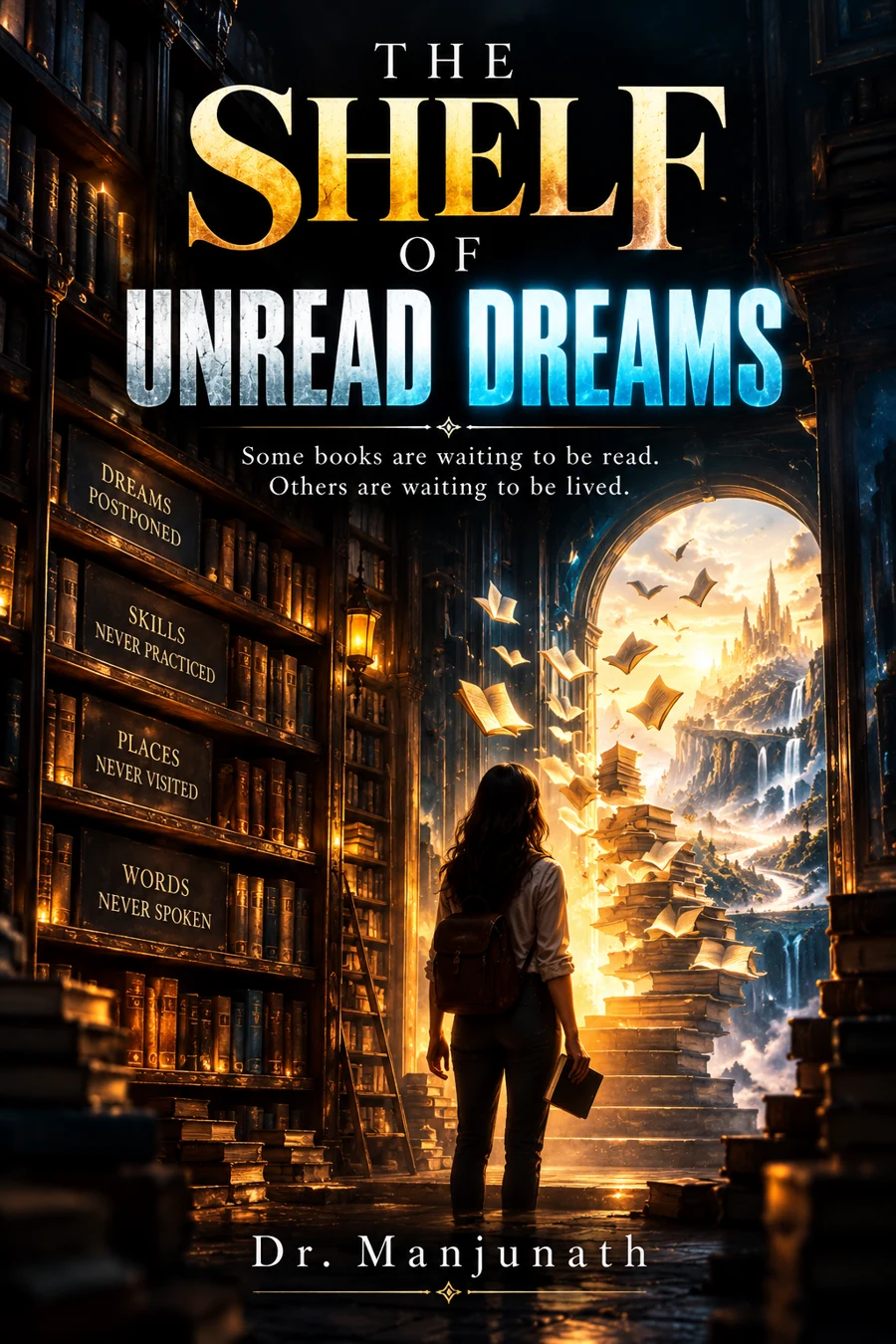
Bookshelves rose from the floor to the ceiling.
But there were no neatly organized categories.
Instead, each shelf carried a handwritten label.
WORDS NEVER SPOKEN.
JOURNEYS NEVER TAKEN.
SKILLS NEVER PRACTICED.
DREAMS POSTPONED.
Meera stared at the labels.
"What kind of bookshop is this?"
"The kind where people occasionally discover what they're not looking for."
An elderly woman emerged from behind a tall shelf.
She had silver hair tied in a loose bun and wore a dark green shawl.
"Good evening," she said.
Meera pointed toward the window.
"There's a book outside with my name on it."
"Is there?"
"Yes."
"How interesting."
"Did you put it there?"
"I put many books in the window."
Meera frowned.
"Who wrote it?"
The woman smiled.
"Perhaps you should open it."
The Empty Pages
Meera carried the book to a small wooden table.
She opened the first page.
Blank.
The second page.
Blank.
The third.
Nothing.
She flipped through the entire book.
Every page was empty.
"There's nothing here," she said.
"Are you sure?"
Meera held the book toward the woman.
"Look for yourself."
The elderly woman sat across from her.
"What were you expecting?"
"A story."
"About whom?"
"Me, apparently."
"And what kind of story were you hoping to find?"
Meera paused.
"I don't know."
The woman leaned forward.
"Then perhaps that's why the pages are empty."
Meera laughed nervously.
"Is this some kind of philosophical bookstore?"
"Only when customers ask philosophical questions."
"Well, I don't have time for riddles."
She closed the book.
"I need to go."
The woman nodded.
"Of course."
Meera stood.
But something made her look toward the shelf marked SKILLS NEVER PRACTICED.
A thin blue book was lying slightly out of place.
She recognized it immediately.
Drawing Light: A Beginner's Guide to Sketching.
She owned that book.
Or at least, she had owned it years ago.
Meera pulled it from the shelf.
Inside the front cover was a familiar signature.
Meera Rao Age 17.
Her handwriting.
Her book.
Her breath caught.
"Where did you get this?"
The elderly woman looked at the cover.
"It came with several boxes of donated books."
Meera remembered.
Her mother had moved into a smaller apartment six months earlier.
She had asked Meera to collect some old belongings.
Meera had been too busy.
Eventually, her mother donated the boxes.
Meera opened the sketching book.
The first twenty pages were untouched.
Then she found something folded between two chapters.
A drawing.
A young girl's drawing of a window beside a tree.
Uneven lines.
Careful shading.
A small bird perched on the branch.
At the bottom, in pencil, were the words:
One day, I want to draw the whole world.
Meera recognized the picture.
She had drawn it after school.
Eighteen years ago.
She had forgotten it existed.
The elderly woman watched her quietly.
"Did you ever finish drawing the world?"
Meera ran her fingers across the faded pencil lines.
"No."
"What happened?"
"Life happened."
The woman nodded.
"It often does."
The Shelf That Looked Different
A distant clock struck ten.
Meera should have left.
Instead, she walked deeper into the shop.
There was another shelf near the back.
It had no label.
Unlike the others, its books were untidy.
Some had torn covers.
Others had folded corners, loose pages and handwritten notes.
A cookbook was stained with oil.
A book about gardening contained dried flower petals.
An old photography manual had grains of sand trapped between its pages.
Meera picked up a battered music book.
Its spine was almost broken.
"These books are in terrible condition," she said.
The woman approached.
"Yes."
"Why don't you restore them?"
"Because there's nothing wrong with them."
"But they're damaged."
"Look again."
Meera examined the cookbook.
Between two recipes was a handwritten note.
Too much salt. Try again Sunday.
She opened the gardening book.
A photograph fell out.
It showed a smiling couple standing beside a small garden.
The flowers in the photograph matched the dried petals.
She picked up the photography manual.
Inside was a faded train ticket and a note.
My first trip alone. I was terrified. I went anyway.
Something about the books felt different.
They weren't merely collections of information.
They held traces of someone's life.
"Who owned these?" she asked.
"Different people."
"Why are they here?"
"Some were donated. Some were left behind. Others were brought here by people who wanted someone else to discover them."
Meera looked toward the neatly arranged shelves.
Their covers were perfect.
Their pages were clean.
Their spines barely opened.
Then she looked at the worn books.
And understood why the woman had kept them separate.
"These books have been used," Meera said.
"Yes."
"Really used."
The woman smiled.
"Some people read books to finish them. Others keep returning to the same page until something in their life begins to change."
Meera ran a finger across a coffee stain.
"And the marks?"
"Evidence that the book left the shelf."
Meera looked down at the books in her handbag.
Perfect covers.
Perfect pages.
Not a single mark.
For the first time, she wondered what her own books would reveal about her.
The Question She Couldn't Answer
"Can I ask you something?" the elderly woman said.
Meera nodded.
"What is the most important thing you've learned from all the books you've read?"
"That's difficult."
"Take your time."
Meera thought.
"Discipline is important."
The woman waited.
"Consistency matters."
Silence.
"And we should keep learning throughout life."
"Those sound like good ideas."
Meera smiled.
"They are."
"Which one changed how you lived yesterday?"
Meera looked up.
"Yesterday?"
"Yes."
She tried to remember.
Yesterday had been a normal day.
Meetings.
Emails.
A presentation.
Dinner while watching something on her phone.
Thirty minutes reading before bed.
"I suppose I was very busy."
"I see."
The woman reached for a book on the table.
"Have you ever met someone who knows how to swim but has never entered water?"
Meera laughed.
"That doesn't make sense."
"Perhaps they have watched every swimming lesson. Studied every movement. Memorized every breathing technique."
"They still wouldn't know how it feels."
"Exactly."
Meera fell silent.
Then she said something she had never admitted aloud.
"I think I'm afraid."
The woman waited.
"Of what?"
"Of discovering I'm not as good as I imagined."
She looked toward her old sketching book.
"When I read about painting, I can imagine being a wonderful artist."
Her voice softened.
"But if I actually pick up a pencil, I'll have to see what I can really draw."
The elderly woman nodded.
"And what would happen if the drawing wasn't very good?"
Meera smiled sadly.
"I'd be disappointed."
"For how long?"
"I don't know."
"And what would you do next?"
Meera looked at the worn sketching book.
"I suppose I could try again."
The woman smiled.
"That sounds like a beginning."
The shop became quiet.
For a moment, Meera could hear the rain returning outside.
She looked down at her seventeen-year-old drawing.
The lines were imperfect.
The proportions were wrong.
The shading was uneven.
But the girl who drew it had not been afraid of any of those things.
She had simply wanted to draw.
Meera wondered when she had started believing that every beginning needed to be impressive.
The First Page
The elderly woman returned with a small wooden box.
Inside were several pencils.
Some were short.
Some had blunt tips.
One had been sharpened so many times that barely half remained.
She placed the box in front of Meera.
"Would you like to try?"
Meera looked at the pencils.
"Here?"
"Why not?"
"I haven't drawn anything in years."
"Then this will be your first drawing in years."
"What should I draw?"
The woman gestured toward the window.
Rain was sliding down the glass.
Across the street, a single streetlight illuminated an empty bench.
"Whatever you notice."
Meera opened her old sketching book.
She turned past the drawing of the bird.
Past the blank pages.
Until she found a clean sheet.
Her hand hesitated.
The woman said nothing.
Meera placed the pencil against the paper.
One line.
Then another.
She drew the window.
The streetlight.
The bench.
Her lines were uncertain.
Her proportions were awkward.
The streetlight looked slightly crooked.
Halfway through, she nearly stopped.
Then she remembered something.
She was not preparing a picture for an exhibition.
Nobody was judging her.
She was simply drawing.
Twenty minutes passed.
When she finally lifted the pencil, she laughed.
"It's terrible."
The elderly woman examined it.
"Perhaps."
Meera looked offended.
The woman laughed too.
"You asked for honesty."
"I know."
"Would you like to draw another?"
Meera looked down at the page.
Then toward the rain.
"Yes," she said.
And this time, she did not wait.
The Book She Didn't Buy
It was almost eleven when Meera stepped outside.
The rain had stopped.
The elderly woman handed her the old sketching book.
"You should keep this."
"How much do I owe you?"
"Nothing. It was yours."
Meera looked toward the mysterious blue book in the window.
The Life You Almost Lived.
"What about that one?"
"Would you like to buy it?"
Meera hesitated.
An hour earlier, she would have purchased it without thinking.
Another book.
Another beginning postponed.
But now she held a sketching book with one fresh drawing inside.
"Not tonight," she said.
The woman smiled.
"Very well."
Meera walked home.
Her handbag contained three new books.
She placed them on her shelf.
Then she set the old sketching book on her desk.
The next morning, before opening her email, she took out a pencil.
She drew the cup of tea beside her.
It was not beautiful.
The handle was too large.
The shadow looked strange.
But she finished it.
At the bottom, she wrote the date.
Then, underneath:
Day 2.
Over the following weeks, the sketching book began to change.
There were crooked buildings.
A sleeping dog.
The view from her office window.
Her mother's hands holding a cup.
A little boy selling flowers beside a traffic signal.
Some drawings were terrible.
A few surprised her.
But every page held something that none of her pristine books had contained.
A moment she had actually lived.
One evening, she returned to the street where the mysterious bookshop had stood.
The wooden door was locked.
The window was empty.
There was no signboard.
No light.
Meera stood there for a while.
She wanted to thank the old woman.
But perhaps, she thought, the woman had already given her everything she needed.
She turned to leave.
Then noticed a small handwritten card taped to the inside of the glass.
It contained only seven words.
SOME STORIES BEGIN AFTER YOU CLOSE THE BOOK.
Meera smiled.
She reached into her handbag.
Not for another book.
For her pencil.
And standing beneath the streetlight, she began to draw.
What was really waiting on the shelf?
Theme: Learning, knowledge application, perfectionism and personal growth.
Three key takeaways
- Knowledge is only the beginning. Reading expands possibilities, but practicing helps us turn understanding into capability.
- Progress doesn't require a perfect start. Beginning while imperfect allows you to learn from real experience.
- Learning becomes meaningful through application. One idea practiced consistently can be more valuable than many ideas merely collected.
Reflection question
What is one thing you know you want to do, but have been preparing for instead of actually beginning?
Your 24-hour challenge
Choose one idea from a book you've read recently. Spend 15 minutes applying it in your own life, even imperfectly.
Sometimes, the most important page of a book is the one you begin writing with your actions.